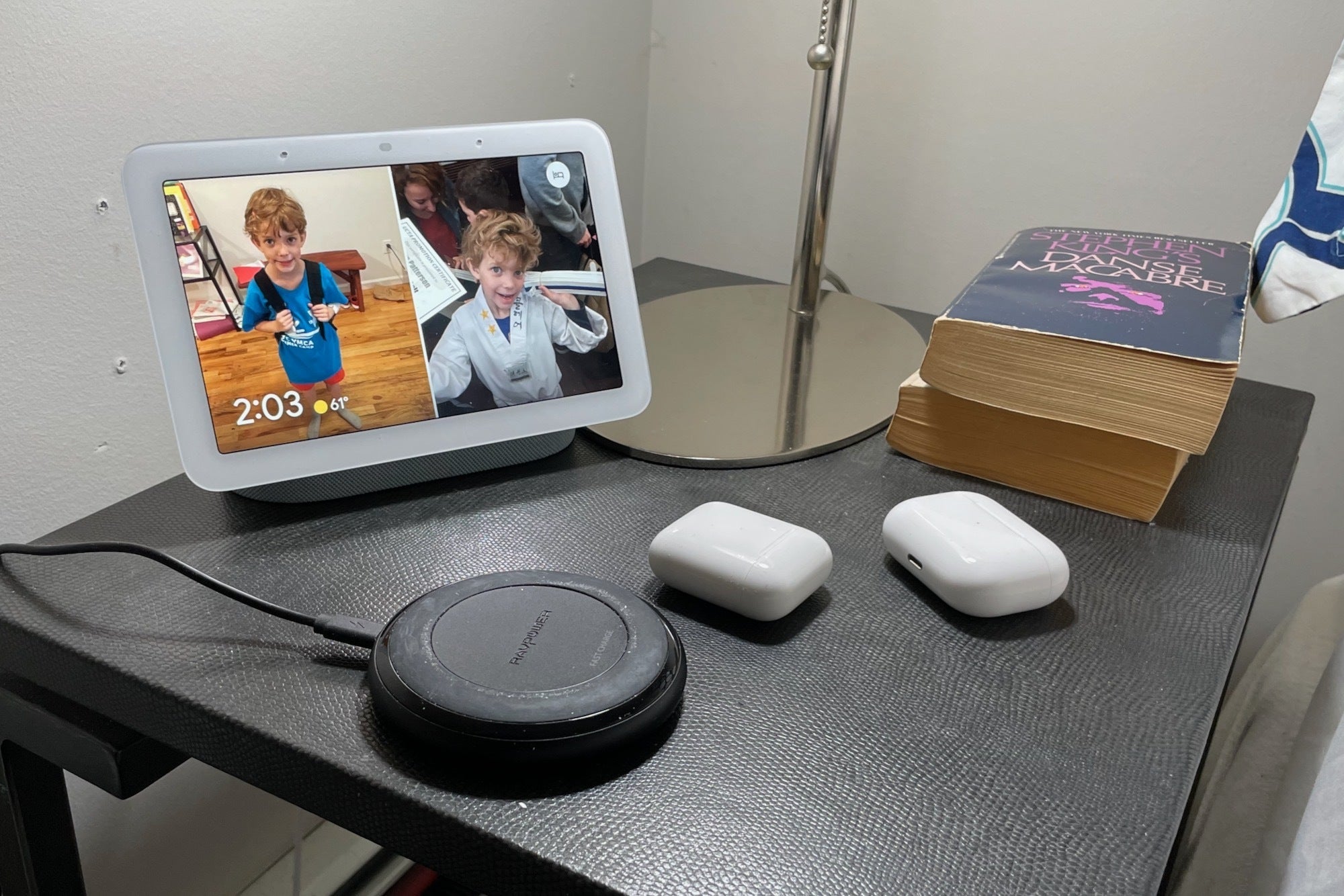
The most significant difference is that Google Nest Hub DOES NOT have a camera for video calling but it does have voice calling. You CAN watch your video doorbell camera and also the Google-owned YouTubeTV on screen, as well as display web pages. And, you can rotate your photos on the video display by linking it to your Google Photos account, so serves as a marvelous smart picture frame. That's in stark contrast to the Echo Show, which allows you to take pictures or host video calls with other Echo devices, or even the newly announced Facebook Portal that seems almost entirely focused on video calling. If you already have a smart speaker or smart display from either brand in your home, then it makes sense to opt for the same manufacturer as they’ll work together, for example creating a multi-room music system. While the second-gen Nest Hub lacks a camera, the display makes up for it with a suite of advanced sleep-tracking features, using Soli technology to monitor overnight movement and breathing.
Bluetooth is a wireless technology standard that allows data transfers between devices placed in close proximity, using short-wavelength, ultra-high frequency radio waves. Dolby Atmos is a surround sound technology that allows sounds to be interpreted as three-dimensional objects. By doing so, Dolby Atmos allows for immersive, 360-degree sound. A passive radiator is a type of driver that doesn't have a voice coil and a magnet. The sound vibrations produced by a passive radiator depend on its mass and the size of its enclosure.
What Is Apple Pencil Hover & How Does It Work?
The Echo Dot connects to its power supply with a barrel connector, while the Google Home Mini uses a USB power supply. Devices with stereo speakers deliver sound from independent channels on both left and right sides, creating a richer sound and a better experience. Google's screen is also supported by a much smaller speaker underneath - around the same size as the Google Home Mini - giving the impression of an almost floating display. In terms of display size, the Google Nest Hub 2 has a 7-inch screen with a 1024 x 600 resolution, where the Echo Show 8 has an 8-inch display, with a 1200 x 800 resolution.
They can even get live video from certain compatible smart security cameras andvideo doorbells. We’ve praise the Echo Show for its top-notch sound quality, a laurel hard to come by with any smart display. The best smart speaker for you ultimately depends on what you plan to use it for.
Calls
That means you can start your day with tailored information on the day's weather, your commute, upcoming calendar meetings and anything else you've set up the Hub to remind you about. Upgrade your lifestyleDigital Trends helps readers keep tabs on the fast-paced world of tech with all the latest news, fun product reviews, insightful editorials, and one-of-a-kind sneak peeks. For security aficionados, the Echo Show’s Alexa Guard feature will have it listening for smoke and carbon monoxide alarms, as well as the sound of glass breaking. While the standard Alexa Guard is free, Alexa Guard Plus runs $5/month and adds periodic panning to the mix.
It is usually used in combination with a woofer to produce deep bass tones. The Google Home Hub is also perfectly placed to make use of Youtube - you know, the biggest video sharing site on the internet - that is also owned by Google's parent company Alphabet. There's an integrated Youtube app optimized for the display, and seems geared directly towards How To videos, as well as songs and playlists for...
Design and screen
It can understand different requests more easily than Alexa, and that's very appealing. Both have a touchscreen display, however, as well as a physical mute button , a volume button on the back, and a power port. Keep in mind that, with both Alexa and Google Assistant, third-party speaker manufacturers are increasingly choosing to integrate the voice helpers into their own products. Recently Google launched a follow up to its smallest smart speaker; the Google Nest Mini comes with three speakers (that's one more than the original), and is made from recycled materials. With Google Assistant, your Google Home can control your Philips Hue lightbulbs, Honeywell thermostat, Nest security camera, and smart TV (as long as it's compatible).

The new Google Nest Mini is set to sound even better too, withy the inclusion of an extra speaker. Alexa's Drop In feature only works with other Alexa-enabled devices. That's a tough question because they're both similar and we find it difficult to pick between the two. Which one you decide to go with may well depend on which you personally prefer and what kind of products you're using than which is technically 'better'. You're interested in upgrading your home with a ton of cool connected tech, but you've waited a few years just to let all the early bugs get ironed out.
It tends to require very specific syntax, though, especially when activating and using most of those skills. It makes Alexa a bit hard to talk to unless you get used to phrasing requests how Alexa wants to receive them. It may be a better option if you use a lot of other Google products, such as Google Calendar, Reminders, and Duo for calls.

In the same way that the first Echo Plus offered more functionality and features than the Google Home, the Echo Plus has doubled-down by offering the same great features in a more compact and visually appealing package. With the Echo Plus, you can start connecting Zigbee-compatible bulbs, switches, outlets, and other smart home products right out of the box without needing to invest in a dedicated smart home hub. The home is becoming a hub of smart devices designed to make your life easier. We consider a lower weight better because lighter devices are more comfortable to carry. A lower weight is also an advantage for home appliances, as it makes transportation easier, and for many other types of products. Not to forget, this is a smart home device we're talking about.
Let's break down the most important aspects to help you decide. While these two devices share a lot in common, they also have significant differences in design, price, and capabilities. Here’s what you need to know about their similarities and differences.
For those concerned with privacy and hacking issues, the Nest Hub may actually be a more attractive option because it lacks a camera. That said, there’s a whole layer of video-based features that Nest users will simply not be able to access. The Echo Show 10 has a 10.1-inch touch screen with 1,280-by-800-pixel resolution. The Nest Hub Max has a comparable display that's just a fraction of an inch smaller , with the same resolution. The Echo Show 5 and Nest Hub are both much smaller, respectively featuring 5.5-inch, 960-by-480 and 7-inch, 1,024-by-600 screens. The Echo Show 8 sits between the two extremes, with an 8-inch screen that has the same 1,280-by-800 resolution as the Echo Show and Nest Hub Max, for the sharpest picture.


No comments:
Post a Comment